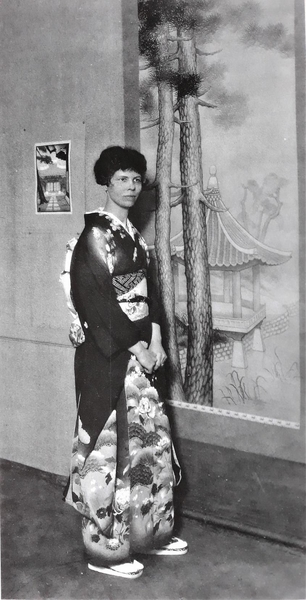
Photo of Lilian Miller taken circa 1910 and signing “Your boy Jack”
Lilian May Miller (July 20, 1895 – January 11, 1943) was an American painter, woodblock printmaker and poet born in Tokyo, Japan. Trained in Japan in traditional painting styles and techniques, Lilian May Miller created artworks representing people and landscapes from Japan and Korea, the countries where she spent most of her life.
Her birth in Japan was a result of her father, Ransford Miller, being an American diplomat who had worked for the YMCA in Tokyo from 1890 to 1894. From 1895 to 1909 he was a legation interpreter. In 1894 he married Lilly Murray, who had arrived in Japan in 1888 and taught English. Lilian had a sister named Harriet, who her father called “Hal”. Lilian was called “Jack”, a name she frequently used to refer to herself.
In 1904, nine-year-old Lilian was enrolled in the atelier of Kano Tomonobu (1843–1912), who was the 9th generation head of the famous Kano school in Tokyo. Three years later she would exhibit her first works and go on to be a student of Shimada Bokusen at the age of twelve. Her chosen professional name was ‘Gyokka’ which means jeweled flower. Not long after the start of her tutelage with Bokusen, Lilian’s father became head of the State Department’s Far Eastern Department and was transferred to Washington, D.C. For the first time in her life, Lilian left Japan and went to the United States. She attended Central High School in Washington, D.C. and at the age of 14 won first place in the Washington Post art contest with a piece titled Early Morning in Old Japan. She went to Vassar College in New York and graduated with honors in 1917.
In 1918, Lilian went to Seoul, Korea for a short period of time where her father was now the American Consul General. She then lived with her parents in New York until returning to Tokyo in 1920. She resumed her artistic study with Bokusen and with his encouragement entered a large scroll painting entitled In a Korean Palace Garden into the Imperial Salon at the Imperial Academy of Fine Arts. This competition was dominated by roughly 500 other competitors, almost exclusively Japanese men, but she was still able to be one of just five artists honored with a ‘Golden Scroll’ award. This was a major breakthrough for Lilian, as she was becoming accepted as an authentic Japanese artist. This breakthrough was undermined by the fact that this painting would still not fetch a very high price, and with the time it takes to make paintings, Lilian found the medium unprofitable, which fueled her turn to woodblock prints in an attempt to truly make a living as an artist.
Lilian was able to find financial success with a career in print, and was said to have produced more than 6,000 prints and cards from 1920-1923, selling them in major cities and doing presentations on her work. Her career was put on hold in 1923 when the Great Kanto Earthquake struck while she was visiting her parents in Seoul, destroying her studio and most of her work. Lilian also fell greatly ill at this time, and had to move back in with her parents from 1923-1927. Her career picked back up with her recovery in 1927, and she was able to sufficiently restore her body of work as well as make a six month trip to America to demonstrate her work in several cities across the country. Her Career bloomed most between the years of 1927-1935, after which she began to experience more health issues, this time a cancerous tumor that resulted in a hysterectomy. In 1936 a mass assassination of several Japanese government officials by radical officers lead Lilian and her mother to move to Honolulu, Hawai’i. Watercolor became her main medium then, until she began branching out into lithography and ink paintings upon moving to San Francisco in 1938.
The 1941 Japanese attack on Pearl Harbor lead Lilian to turn against Japan and give up painting as well as consider destroying earlier prints, having felt betrayed by the country. During the war, she worked against the Japanese. She signed on with a Naval counter propaganda branch as a Japanese censor and research analyst. On December 9, 1942, she had surgery to remove another abdominal tumor at a hospital at Stanford University. She died on January 11, 1943 of abdominal cancer in California. Her ashes were buried at Woodlawn Cemetery in San Francisco.